
The Annex Neighbourhood Guide
By Antony Malfara, B.Comm., Broker, Royal LePage Signature Realty (RECO 4786256). Last updated: October 2026.
Living in the Annex
The Annex is one of Toronto's most loved old neighbourhoods: rows of big Victorian and Edwardian brick houses, leafy side streets, and a stretch of Bloor Street full of restaurants, cafés and shops. The traditional boundaries are Bloor Street to the south, Dupont Street to the north, Bathurst Street to the west and Avenue Road to the east. The City's wider definition also takes in Seaton Village, west of Bathurst, and Yorkville.
With the University of Toronto just south of Bloor, the Annex has always mixed students, professors, young families and long-time owners. It is lively, walkable and very central, with four subway stations around its edges.
A little history
In 1886 developer Simeon Janes laid out a subdivision he called the Toronto Annex, and the area joined the City of Toronto in 1887. Seaton Village to the west followed in 1888. Most of the houses were built between 1880 and the early 1900s. Architect E. J. Lennox, who later designed Casa Loma and Old City Hall, designed a house at 37 Madison Avenue in 1887 that was copied so widely it gave its name to the "Annex style" house.
In the 1950s and 60s some houses were torn down for apartment buildings. Then residents fought back. They organized against the Spadina Expressway, which would have split the neighbourhood in half, and it was cancelled in 1971. A height limit in 1975 helped save most of the original houses, and today over 500 buildings in the area are heritage protected.
What the homes are like
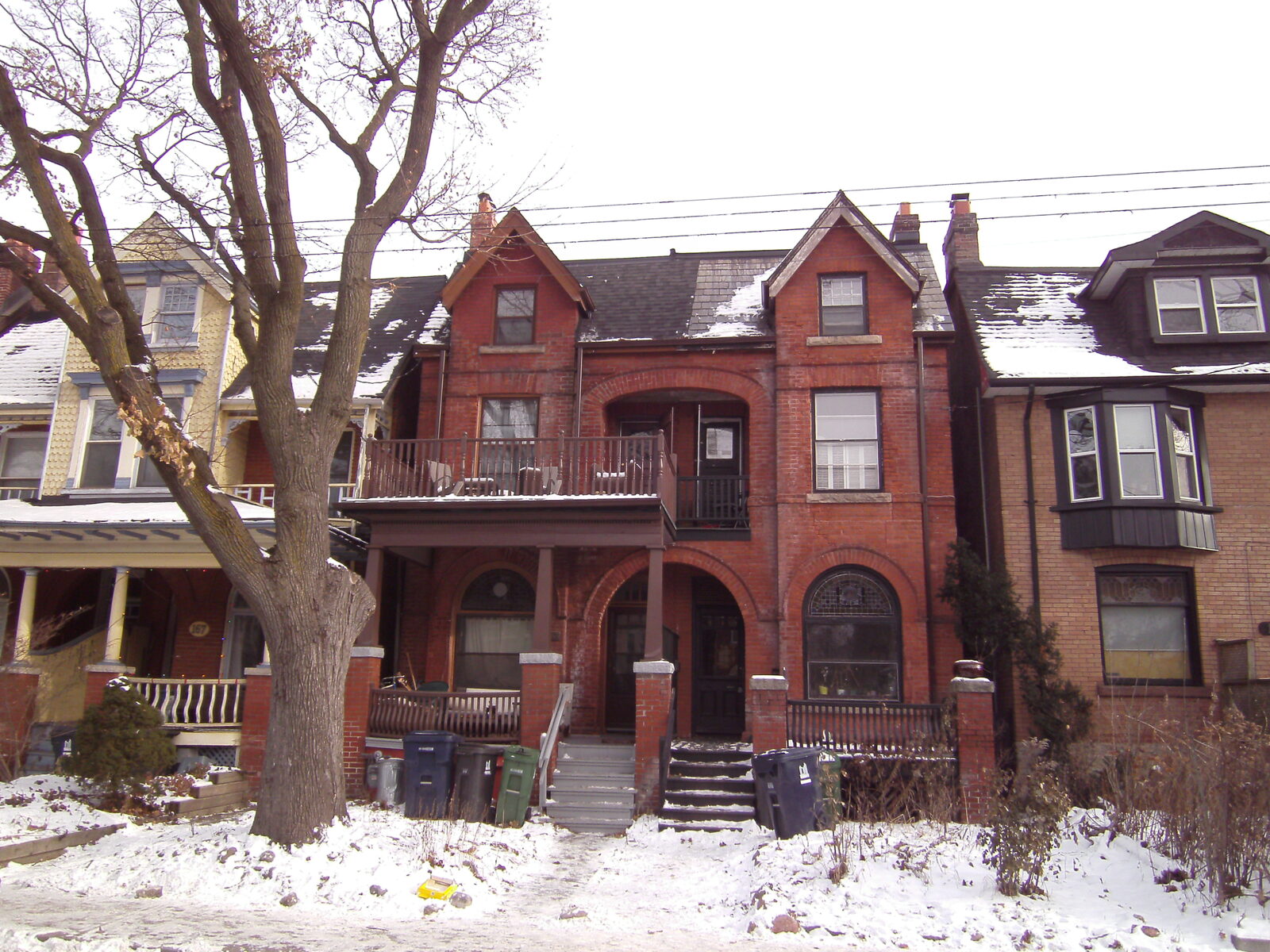
Victorian and Edwardian houses: the classic Annex home. Large brick detached and semi-detached houses from the late 1800s and early 1900s, many with stone bases, turrets, arched porches and original details.
Converted houses: many of the bigger homes have been split into apartments over the years.
Apartments and condos: mid-rise and a few high-rise buildings from the 1950s and 60s, plus newer buildings near Bloor, including Mirvish Village at Bloor and Bathurst.
What homes cost
The Annex is part of TRREB district C02, which also covers Casa Loma, Wychwood, Yorkville and Yonge and St. Clair. In September 2026:
Detached benchmark price: $2,565,300, down 0.9% from a year earlier
Semi-detached benchmark: $1,818,500, down 2.5%
Condo apartment benchmark: $796,000, down 3.0%
Composite benchmark (all home types): $1,295,900, down 0.9%
Homes sold: 58 across all types, at a median of $1,472,500
Days on market: 38 on average, 25 for detached homes
Sale-to-list ratio: 98%
Months of inventory: 5.7
Condos sold for an average of $1,690,737 in C02, far above the benchmark, because large luxury suites in Yorkville pull the average up. The benchmark is the better guide for a typical Annex condo. House prices have held up better here than in most of Midtown, but there is more inventory, so buyers can take their time. For a real number on a specific home, ask me for a free evaluation.
Schools
Catchments are set by address and can change, so always confirm with the school board before you buy.
Huron Street Junior Public School (JK to 6), on Huron Street in the heart of the Annex
Jesse Ketchum Junior and Senior Public School (JK to 8), on Davenport Road, the middle school for much of the area
High school: Harbord Collegiate Institute or Jarvis Collegiate Institute, depending on the address
Seaton Village and the west side: some streets near Bathurst are zoned for different schools, so check carefully.
Catholic: use the TCDSB school locator to find the Catholic school for your address.
Private: University of Toronto Schools (UTS) at Bloor and Huron
Getting around
Line 2 Bloor-Danforth: Bathurst, Spadina and St. George stations along Bloor.
Line 1: St. George, Spadina and Dupont stations. St. George and Spadina are transfer stations between Lines 1 and 2.
Streetcars and buses: streetcars run south from Bathurst and Spadina stations, and buses run on Avenue Road, Spadina Road, Dupont Street and Davenport Road.
Line 5 Eglinton: open since February 2026, a short ride north on Line 1 to Cedarvale or Eglinton station.
You can easily live here without a car. Street parking is tight, so check whether a home has a parking pad or laneway garage.
Things to do
Bloor Street between Avenue Road and Bathurst: restaurants, cafés and independent shops.
The Bata Shoe Museum at Bloor and St. George, and Koerner Hall at the Royal Conservatory on Bloor, a concert hall known for its sound.
Mirvish Village at Bloor and Bathurst, on the site of the old Honest Ed's store, which closed at the end of 2016.
Jean Sibelius Square, a neighbourhood park at Kendal Avenue and Wells Street with a playground.
The University of Toronto campus and the Royal Ontario Museum, a short walk south and east.
The honest take
It is busy and urban. Bloor Street is lively day and night, and with so many students nearby, some streets can be louder than others.
Old houses need care. Many homes are well over 100 years old. Wiring, plumbing, foundations and roofs all need a close look, and converted houses can hide years of patchwork.
Heritage rules apply. With so many protected buildings, check what you can change before you plan an addition or a new front.
Parking is limited. Many homes have no parking at all, which matters for resale.
Buying or selling in the Annex
If you are buying: know whether you want a single-family home, a house with income suites, or a condo, because the Annex has all three. For a converted house, check that the units are legal and get a thorough inspection. Check the school catchment for every address.
If you are selling: lead with the character and the location: original details, the walk to the subway, Bloor Street and the university. Be clear about parking, rental units and any updates. With 5.7 months of inventory in C02, price it right from day one. Well-priced homes in C02 are selling at about 98% of asking.
Common questions
Where is the Annex? The traditional Annex runs from Bloor Street north to Dupont Street, between Bathurst Street and Avenue Road. The City's wider definition also includes Seaton Village and Yorkville.
What do homes cost in the Annex? In September 2026 the detached benchmark price in TRREB district C02, which includes the Annex, was $2,565,300, the semi-detached benchmark was $1,818,500 and the condo apartment benchmark was $796,000.
What is an Annex style house? It is a late 1800s Toronto house style made popular by architect E. J. Lennox's 1887 design at 37 Madison Avenue, which builders across the neighbourhood copied.
How many subway stations serve the Annex? Four: Bathurst, Spadina, St. George and Dupont. Spadina and St. George connect Line 1 and Line 2.
How fast do homes sell in the Annex? In September 2026 homes in district C02 sold in 38 days on average, and detached homes in 25 days.
Thinking about the Annex?
Whether you are buying your first condo, a family home or a house with suites, or getting ready to sell, I will give you a straight, street-level read on the market. Call or text me at (416) 709-0988, or request a free home evaluation. Live listings in The Annex are below.
Market figures: TRREB Market Watch, September 2026, district C02. School information from the TDSB, TCDSB and school websites as of September 2026; confirm your address with the board.
About the author
Antony Malfara, B.Comm., Broker, Co-Team Lead, Property Boys, Royal LePage Signature Realty, Brokerage. Over 10 years in Toronto real estate, 500+ transactions and more than $350 million in sales, focused on Midtown and North Toronto. RECO registration 4786256. CLHMS, MCNE. Speaks English, Italian and French. More about Antony. Last updated: October 2026.
More questions about the Annex
The traditional Annex runs from Bloor Street north to Dupont Street, between Bathurst Street and Avenue Road. The city's wider definition also includes Seaton Village, west of Bathurst, and Yorkville. The University of Toronto sits just south of Bloor, and the neighbourhood mixes students, professors, young families and long-time owners.
The classic Annex home is a large Victorian or Edwardian brick house from the late 1800s or early 1900s, detached or semi-detached, often with a stone base, turrets, arched porches and original details. Many bigger homes have been converted into apartments. There are also mid-rise and some high-rise buildings from the 1950s and 60s, plus newer buildings near Bloor.
An Annex style house is a late 1800s Toronto house style made popular by architect E. J. Lennox's 1887 design at 37 Madison Avenue, which builders across the neighbourhood copied. Lennox later designed Casa Loma and Old City Hall. Classic Annex houses are large brick homes, often with stone bases, turrets and arched porches.
Four subway stations serve the Annex: Bathurst, Spadina, St. George and Dupont. Spadina and St. George connect Line 1 and Line 2, and streetcars run south from Bathurst and Spadina stations. Line 5 Eglinton is a short ride north on Line 1 to Cedarvale or Eglinton station, so living in the Annex without a car is easy.
The main downsides of the Annex are noise, older homes, heritage rules and parking. Bloor Street is lively day and night, and some streets near students are louder. Many homes are well over 100 years old, and converted houses can hide years of patchwork. With over 500 heritage-protected buildings, changes need checking, and many homes have no parking at all.
Compare and run the numbers
Compare: All neighbourhood guides
Run the numbers: Which neighbourhood fits you? · What can I afford? Budget Map · Toronto sell rate map · Cost to own calculator · Land transfer tax calculator · Seller net proceeds calculator